Perception of facial cues in early development

How do infants learn what a facial movement or a shift in someone’s gaze means? I combine EEG, eye-tracking and observations of caregiver–infant interactions to study how early social experience shapes the perception of faces.
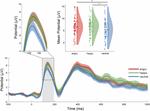
Our 2026 study of caregiver mirroring found that by 30 months, children’s brain responses reflected the individual facial movements that make up expressions. At nine months, the strength of this pattern varied across infants and was associated with how often their mothers had directly mirrored their facial expressions at two months. This builds on our earlier work on facial mirroring and infants’ sensitivity to having their gaze followed.
This research has been supported by a Medical Research Council studentship and a Marie Skłodowska-Curie Individual Fellowship.



Holly Rayson
Developmental cognitive neuroscientist · Research project manager
I study how early social interactions shape the developing brain and contribute to later mental health.