Early caregiver mirroring predicts the emergence of action-unit-based facial representations in the infant brain
Abstract
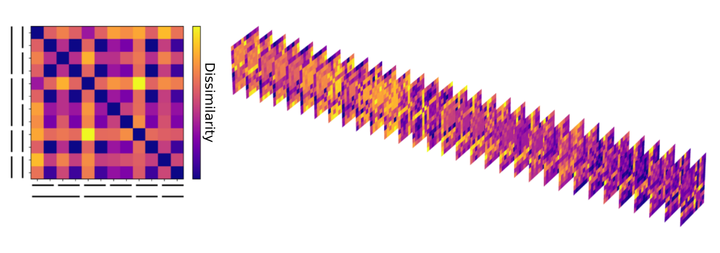
How does early interaction relate to the way the brain represents facial expressions? We analysed EEG recorded while nine-month-old infants and 30-month-old children watched dynamic expressions. By 30 months, neural response patterns reliably reflected the constituent facial movements, known as action units. At nine months, the strength of this representation varied with how often mothers had mirrored their infants’ facial expressions in face-to-face interactions at two months.
Type
Publication
Infant Behavior and Development
Action-unit dissimilarity matrix and frame-by-frame sequence from Figure 1e of Bozicevic et al. (2026), Infant Behavior and Development. © 2026 Elsevier Inc.

Holly Rayson
Developmental cognitive neuroscientist · Research project manager
I study how early social interactions shape the developing brain and contribute to later mental health.